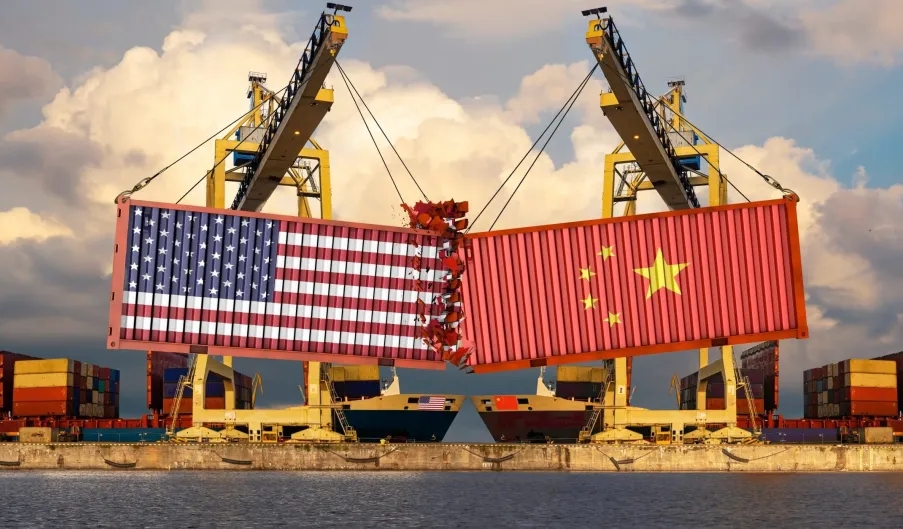
HSBC's latest analysis highlights that the U.S.'s imposition of hefty surcharges on shipping companies using Chinese-built vessels to call at its ports will significantly impact Chinese carriers. COSCO Shipping is expected to incur annual fees of 1.5billion,whileOrientOverseasInternationalwillfacecostsof654 million.
In response to the new U.S. port fee regulations, global leading shipping companies have begun adjusting their strategies, primarily through vessel replacement, route diversifications, and transshipment adjustments.
Maersk, CMA CGM, and MSC have separately stated that they will not impose any additional surcharges on cargo bound for the U.S. as a result.
COSCO Shipping and Orient Overseas may face $2.1 billion in port fees
According to HSBC's latest analysis, Chinese shipping companies will face significant impacts from the upcoming U.S. port fee policy. Among them, COSCO Shipping Holdings may need to incur annual port fees of up to $1.5 billion in 2026, equivalent to 5.3% of its projected annual revenue and eroding 74% of its expected operating profit (EBIT).
In addition to COSCO Shipping, its subsidiary Orient Overseas International (OOIL) will also face significant financial pressure. The company is expected to incur related fees of $654 million in 2026, accounting for 65% of its projected operating profit (EBIT).
Although the final rules have not yet been released, U.S. Customs and Border Protection (CBP) is establishing a fee collection system. Under the U.S. Trade Representative's Office (USTR) plan, this fee mechanism is scheduled to officially take effect on October 14, 2025, potentially significantly altering the operational landscape for global shipping companies.
It is noteworthy that these fees are not exclusively targeting Chinese companies—any shipping enterprise utilizing Chinese-built vessels to call at U.S. ports may be subject to the charges. However, non-Chinese shipping companies generally possess more non-China-flagged fleet resources and have stronger mitigation capabilities. "We believe companies like Maersk and Hapag-Lloyd have sufficient non-China-built vessels at their disposal to avoid the majority of these fees," HSBC noted in its report.
Data shows that in 2024, approximately 15% of tonnage docking at U.S. ports was built in China. Globally, 71% of container shipping capacity (measured in TEU) is currently non-Chinese-made. However, on key trans-Pacific and transatlantic trade routes, this proportion drops to 21%, highlighting Chinese shipbuilders' heavy reliance on core routes.
Peter Sand, Chief Analyst at Xeneta, noted that the new U.S. port fees are yet another example of the increasingly complex global trade environment. He stated: "This represents a gradual tightening that is reshaping shipping companies' operational frameworks. Geopolitical barriers are profoundly impacting global trade, driving up cargo transportation costs."
Three major shipping lines intensify their response
In response to the new U.S. port fee regulations, leading global shipping companies have begun adjusting their strategies, primarily manifested in the following three aspects:
Strategy 1: Vessel replacement
The Maersk-Hapag-Lloyd Gemini alliance has already switched to South Korean-built container ships for its transpacific routes. COSCO Shipping is coordinating with Ocean Alliance partners (including CMA CGM and Evergreen) to increase non-China-built vessel deployment on Pacific routes while reallocating its own fleet capacity to regional markets to avoid U.S. port fee impacts.
Strategy 2: Route segmentation
The Premier Alliance plans to split its existing "Mediterranean-Pacific South 2" (MS2) route into two independent services. Linerlytica analysis suggests this will remove 10 China-built vessels from U.S. port calls.
Strategy 3: Transshipment rerouting
Using hub ports in Canada, Mexico, or the Caribbean for U.S. bound cargo may further boost demand for feeder services.
Maersk, CMA CGM, and MSC have publicly stated that they will not impose additional surcharges on customers due to the new U.S. port fees .
Maersk had previously made clear its commitment to not passing on additional costs to customers. Instead, the company plans to avoid fees through strategic vessel deployment adjustments—leveraging its flexible global network to reallocate China-built vessels to other trade routes, thereby excluding them from U.S.-bound services.
According to Sea-web data, approximately half of MSC's active container fleet was built by South Korean shipyards, while Chinese-built vessels account for about one-quarter of its total fleet capacity.
However, Sea-web records indicate that MSC currently has 106 newbuildings totaling 1.9 million TEU under construction or planned at Chinese shipyards, with no publicly documented orders placed at Korean shipyards.