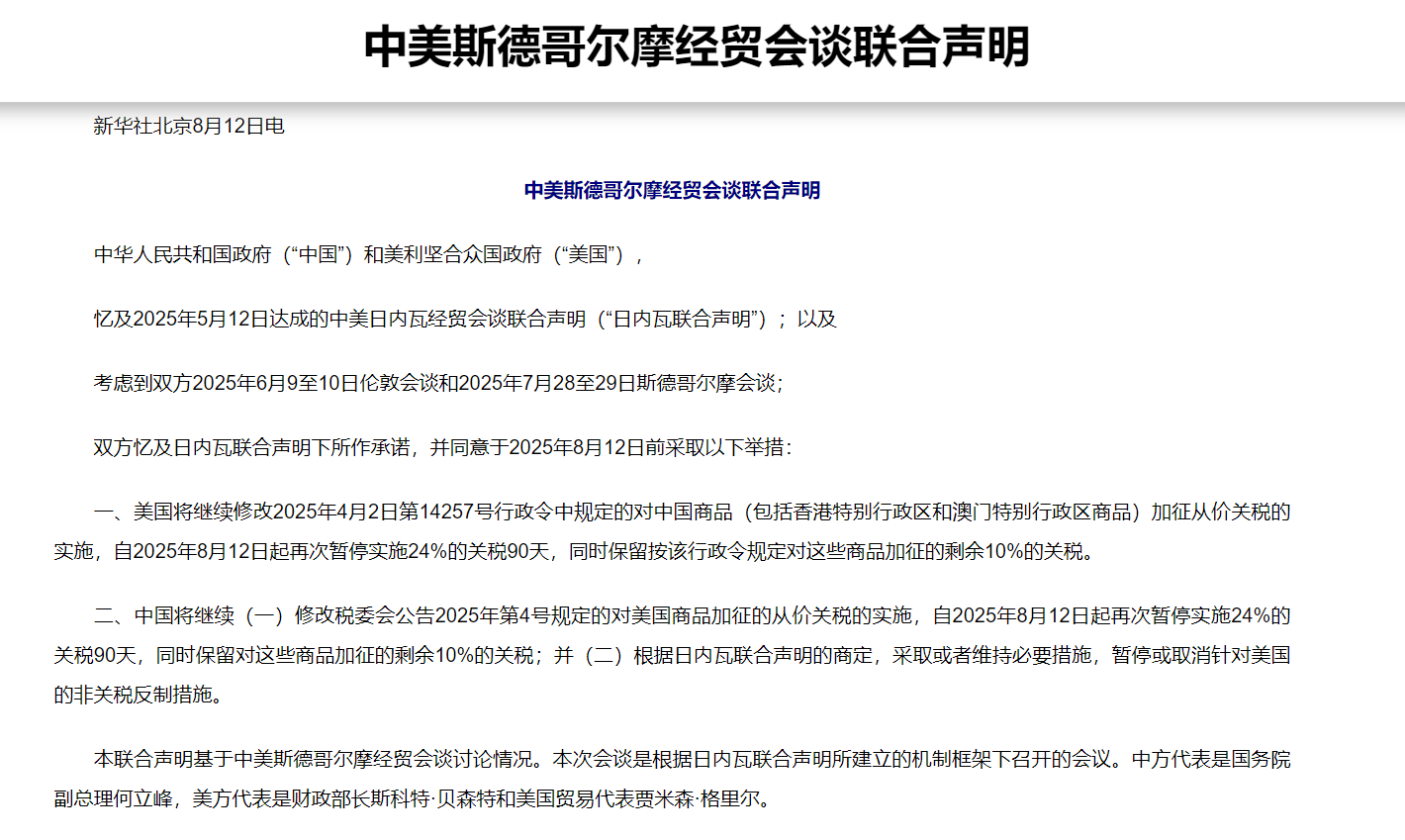
Mutual suspension of 24% tariffs for 90 days, with the remaining 10% tariffs retained.
Core Provisions of the Agreement
U.S. Adjustments
Suspension of 24% tariffs on Chinese goods under Executive Order 14257 for 90 days
Retention of the remaining 10% tariffs (covering goods from Hong Kong and Macau)
China Adjustments
Suspension of 24% tariffs on U.S. goods under Announcement No. 4 of the Tariff Commission (2025) for 90 days
Suspension of 24% tariffs on U.S. goods under Announcement No. 4 of the Tariff Commission (2025) for 90 days
Suspension of non-tariff countermeasures in accordance with the Geneva Declaration
Analysis of Tariff Game Logic
From several rounds of negotiations between the U.S. and other countries, the U.S.'s main demands can be summarized as follows:Buy American goods,reduce U.S. tariffs;Reduce U.S. tariffs,limit China's transshipment.
On August 10, U.S. Treasury Secretary Bessent stated in an interview that reciprocal tariffs should melt like ice over time.
Bessent also noted that tariffs could be gradually reduced or even eliminated if trade imbalances are corrected.
If trade imbalances are not so severe, will tariffs be reduced or eliminated?
This only reaffirms that tariffs are not the solution proposed by the U.S., but rather a bargaining chip. Its true goal is to force major trading partners to make structural changes, such as reducing non-tariff barriers, increasing purchases of U.S. agricultural, energy, or manufactured products—in short, giving the U.S. what it wants.
Tariffs merely create pain, pressuring other countries to adjust their policies proactively. Like antibiotics, they must be discontinued after eliminating the "bacteria" to avoid side effects.
Historical Cases
The 1980s Japan-U.S. auto tariffs case: After the yen appreciation and Japan's voluntary export restrictions, the U.S. gradually phased out its tariffs.
The recent U.S.-EU steel tariffs: The U.S. suspended part of its tariffs after both sides reached an agreement to address overcapacity issues.
Editorial Perspective
Short-term benefit: The 90-day window will reduce trade costs for bilateral businesses, particularly benefiting tariff-sensitive sectors such as machinery, electronics, and chemicals.
Deep-seated challenge: The 10% floor tariff reflects insufficient mutual trust. The next phase of negotiations may focus on:
▶ Conditions for eliminating remaining tariffs
▶ Structural reform issues
Critical 90 days: Can the two sides strike a balance on their core demands?
What will the outcome be in the next 90 days?